
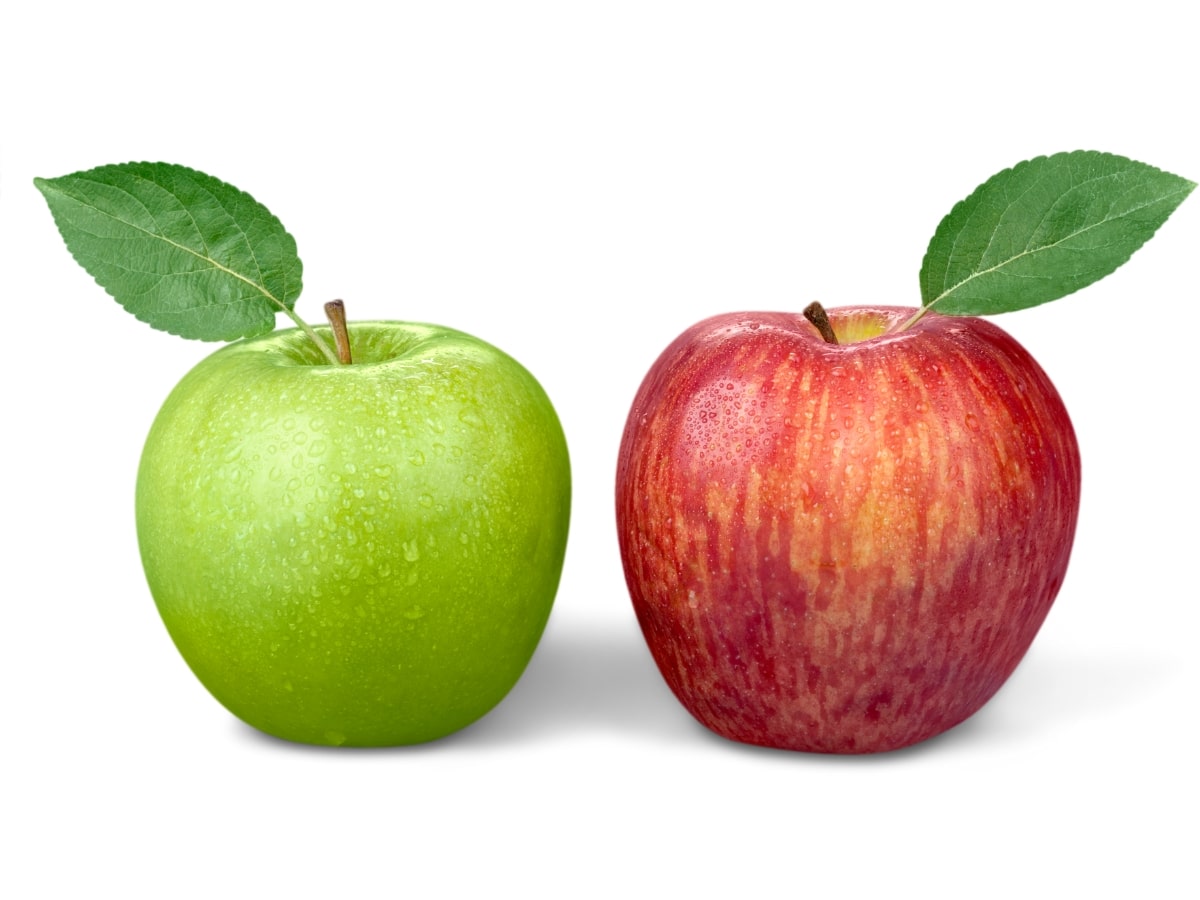
Are green apple benefits truly greater than red apples? Let’s uncover the facts by comparing the sugar, fiber, and antioxidant content of these two nutritious foods.
For this comparison, we’ll use a medium Granny Smith apple vs a medium Gala apple.
Both green and red apples are low-calorie fruits. One medium red apple has about 73 calories, while a medium green apple has around 71 calories. So the two types of apples are virtually identical in terms of energy.
Do Green Apples Really Have Less Sugar?
Because of the tart flavour, many believe that green apples are significantly lower in sugar. In reality, the difference is a small one.
One red apple contains 14.2 g of sugar, compared to 12.7 g in a green apple. The difference of 1.5 g is equivalent to just half a teaspoon of sugar. As a comparison, a standard can of coke contains 9 teaspoons of sugar.
So why do red apples taste so much sweeter? This is due to both the difference in sugar composition as well as acid content.

In terms of sugar composition, 83% of the sugars in red apples are sucrose and fructose, compared to 75% in green apples.
Interestingly, we do not perceive the same sweetness for all sugars. Sucrose is about 30% sweeter than glucose, while fructose could taste two times as sweet as glucose.
Red apples therefore have proportionately more of the two sweeter sugars (sucrose and fructose), and taste much sweeter even though the total difference in sugars in a small one.
The amount of acid in the apples is the second reason why green apples taste less sweet.
Green apples contain up to twice as much malic acid which makes it taste more tart, and this further reduces the perception of sweetness.
Takeaway: Green apples have slightly less sugar, but both types of apples are considered low-glycemic foods, with a glycemic index (GI) of around 35–40. As such, both apples are suitable for people with concerns on blood sugar control.
Do Green Apples Have More Fiber?
If you’re looking to boost your fiber intake, green apples may have a slight edge. A medium green apple offers about 3.0 g of fiber, compared to 2.5 g in a red apple.
More importantly, green apples tend to contain more pectin, a type of viscous fiber known for lowering LDL-cholesterol.
Research has shown that 1 g of pectin per day could reduce LDL-cholesterol by about 2 mg/dL.
As such, 6 g per day of pectin, which is the amount recommended by the European Food Safety Authority (EFSA), could lead to a reduction in LDL-cholesterol of up to 12 mg/dL.
Estimates suggest green apples may contain up to 2.3 g of pectin, which is around 44% more than the 1.6 g in red apples.

Takeaway: Among the key green apple benefits is their higher pectin content, which supports heart health by lowering LDL-cholesterol.
Are Green Apples High in Antioxidants?
Both types of apples are good sources of flavonoids, a family of antioxidants which are concentrated in the skin of apples.
These flavonoids support cardiovascular health by increasing nitric oxide availability and improving blood vessel function.
In fact, having 4 servings of apples per week, compared to less than 1 serving per month, was associated with a 9% lower risk of developing high blood pressure.
Let’s compare the three key flavonoids found in apples:

While green apples have slightly more epicatechin, red apples make up for that difference in terms of quercetin. In addition, only red apples contain cyanidin, a reddish-purple pigment that gives red apples its colour.
Takeaway: Red apples contain more total antioxidants, thanks to the presence of cyanidins.
Which Should You Choose? Green or Red Apples
From a nutritional standpoint:
- Both apples are nutrient-dense, low-glycemic fruits with a good dose of fiber and antioxidants.
- Choose green apples if you’re looking for a viscous fiber boost, particularly from pectin.
- Choose red apples if you prefer a sweeter taste and want a bit more antioxidants.
But ultimately, the best apple is the one you enjoy eating regularly. As such, for most people, it is probably easier to incorporate a sweeter red apple on a daily basis.
If you’d like to include green apples in your diet, they actually work very well in cooking, for example in salads, stews, or even with grains in a rice cooker.
Green Apple Benefits at a Glance
Here’s a quick summary of green apple benefits vs red apples:
- Slightly lower in sugar
- Slightly higher in fiber
- Rich in pectin, which supports cholesterol control
- Low glycemic index – friendly for blood sugar control
- Great for cooking, especially in heart-healthy recipes
If you’d like to watch a video version of this, you can click below.

Ready to Take the Next Step for Your Heart Health?
I’m Chung, an Accredited Nutritionist of Singapore with a Master of Science in Nutritional Sciences. I help clients over 40 manage their LDL-cholesterol, blood pressure, and chronic inflammation through personalized, evidence-based nutrition strategies.
🍎 Wondering how apples (and other real foods) can support your health goals?
Book a free 15-minute strategy session with me today and get started on your journey to better cardiovascular health.
Want to Learn More?
Check out these related resources: